
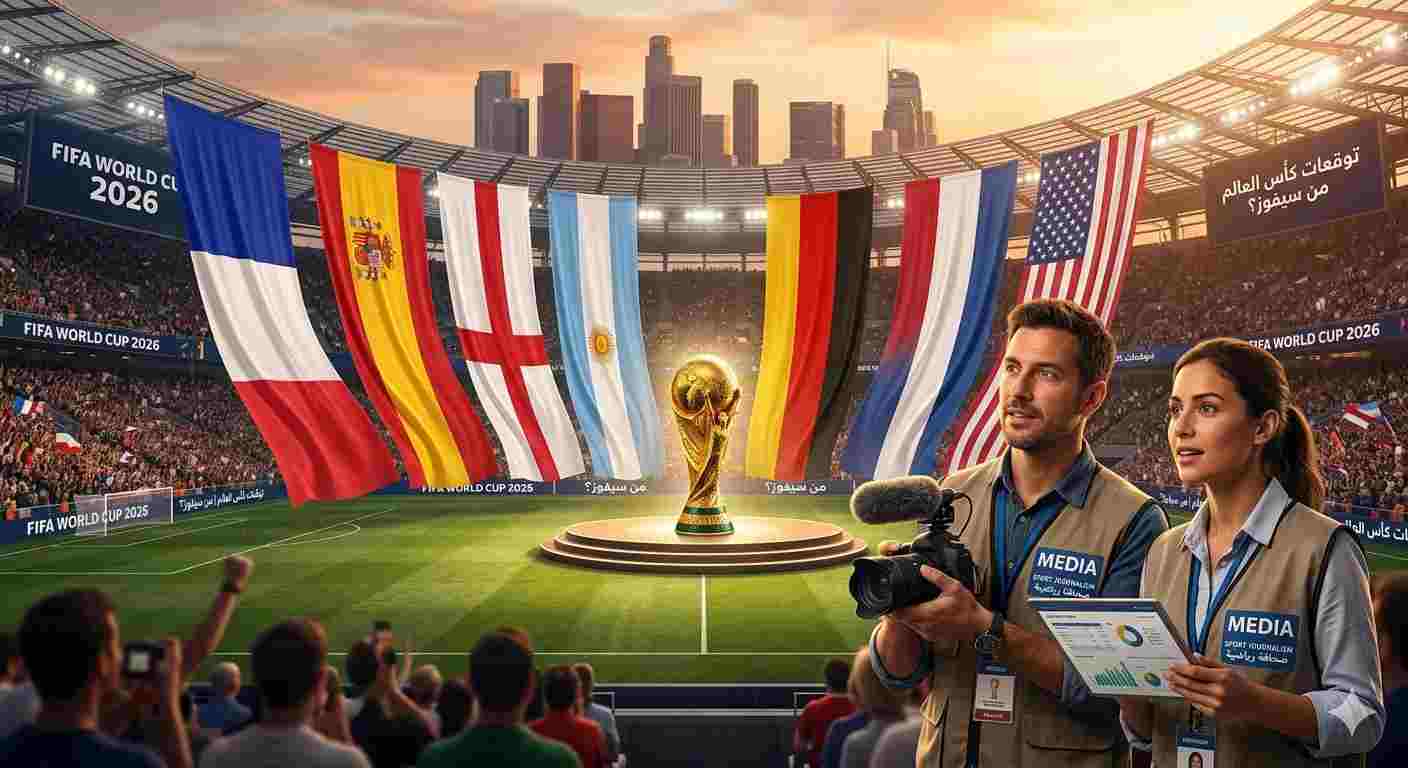
Who Will Win the 2026 World Cup? France Look Closest, but Spain Are the Biggest Threat
Who Will Win the 2026 World Cup? France Look Closest, but Spain Are the Biggest Threat
In a World Cup expanded to 48 teams, the tournament can no longer be judged only by the names of the traditional giants. It must also be measured by each team’s ability to survive a long, demanding competition filled with travel, heat, pressure and unexpected turns.
Yet after following the direction of betting markets, data models, expert analysis, social media debate and football content across major platforms, the most rational answer at this stage appears to be clear: France are the strongest practical candidates to win the 2026 World Cup.
France are not overwhelming favourites, and modern football no longer offers a national team with a 40 or 50 percent chance of winning a World Cup. This is an open tournament. But when we combine squad quality, depth, knockout-stage experience, coaching stability and the presence of a decisive superstar such as Kylian Mbappé, one conclusion stands out: France have the highest competitive ceiling and the fewest major question marks among the leading contenders.
Why France?
France do not always win because they play the most beautiful football. They win because they know how to win in different ways. That is the difference between an entertaining team and a tournament-winning team.
Against a physically strong and well-organised opponent, France may sometimes look unsettled at the beginning of matches. But this team possesses what only major sides usually have: the ability to adjust the rhythm, raise the tempo, control key moments and leave the final word to a player of Mbappé’s calibre.
Mbappé is not merely an attacking star. He is an entire emergency plan. When spaces are closed, he can create them. When the system slows down, he can accelerate the game on his own. In a World Cup, where many knockout matches are decided by a single moment, having such a player is not a luxury. It is a strategic weapon.
But France’s strength does not stop with Mbappé. The team has attacking depth that allows it to change the course of a match from the bench, players capable of operating between the lines, wingers who can stretch the pitch, and a coach who understands the hidden details of this tournament better than most of his rivals.
Didier Deschamps does not need to convince the world that he is the most fashionable modern coach. He simply needs to win. In short tournaments, that mentality can be extremely dangerous.
Spain: The Best Collective Team
If the question is which team plays the most coherent and attractive football, the answer may well be Spain.
Spain entered the tournament as a strong choice in data models and expert analysis, and that is no coincidence. This is a team with a clear identity: pressing, circulation, control and a new generation that has added pace and courage to the country’s traditional footballing school.
Spain’s convincing performances have confirmed that this is not a team built on sterile possession. They are capable of playing vertically when needed, accelerating through the lines and turning control into genuine danger.
The presence of Lamine Yamal gives Spain a rare weapon: a young player who does not wait for the match to offer him space, but creates it himself. Alongside players such as Mikel Oyarzabal and Dani Olmo, Spain appear capable of finding different attacking solutions.
But the main question around Spain is not about the group stage. It is about closed knockout nights. Can they turn possession into goals against France, Argentina or England? Can their defence remain stable when they lose the ball high up the pitch? This is where France still hold a slight advantage.
Argentina: Champions Who Cannot Be Written Off
Argentina remain dangerous because they know what it means to win a World Cup. Lionel Scaloni has built a team that does not depend entirely on Lionel Messi, even if Messi remains the emotional and technical headline of the side.
Argentina’s strength lies in their competitive personality. This is a team that can suffer, defend, wait and then punish opponents at the right moment. That is a valuable quality in knockout football.
But defending a World Cup title is harder than winning it the first time. Some of Argentina’s key players carry golden experience, but they also carry the weight of age, physical demands and the passing of time. In one match, Argentina can beat anyone. Across a long route to the final, the physical question becomes more serious.
England: The Quality Is There, but the Past Still Haunts Them
England have one of the richest squads in world football. In almost every line, there are elite European-level players. Harry Kane gives them a proven scoring reference, while Jude Bellingham, Phil Foden, Bukayo Saka and others provide variety, creativity and attacking depth.
In a World Cup expanded to 48 teams, the tournament can no longer be judged only by the names of the traditional giants. It must also be measured by each team’s ability to survive a long, demanding competition filled with travel, heat, pressure and unexpected turns.
Yet after following the direction of betting markets, data models, expert analysis, social media debate and football content across major platforms, the most rational answer at this stage appears to be clear: France are the strongest practical candidates to win the 2026 World Cup.
France are not overwhelming favourites, and modern football no longer offers a national team with a 40 or 50 percent chance of winning a World Cup. This is an open tournament. But when we combine squad quality, depth, knockout-stage experience, coaching stability and the presence of a decisive superstar such as Kylian Mbappé, one conclusion stands out: France have the highest competitive ceiling and the fewest major question marks among the leading contenders.
Why France?
France do not always win because they play the most beautiful football. They win because they know how to win in different ways. That is the difference between an entertaining team and a tournament-winning team.
Against a physically strong and well-organised opponent, France may sometimes look unsettled at the beginning of matches. But this team possesses what only major sides usually have: the ability to adjust the rhythm, raise the tempo, control key moments and leave the final word to a player of Mbappé’s calibre.
Mbappé is not merely an attacking star. He is an entire emergency plan. When spaces are closed, he can create them. When the system slows down, he can accelerate the game on his own. In a World Cup, where many knockout matches are decided by a single moment, having such a player is not a luxury. It is a strategic weapon.
But France’s strength does not stop with Mbappé. The team has attacking depth that allows it to change the course of a match from the bench, players capable of operating between the lines, wingers who can stretch the pitch, and a coach who understands the hidden details of this tournament better than most of his rivals.
Didier Deschamps does not need to convince the world that he is the most fashionable modern coach. He simply needs to win. In short tournaments, that mentality can be extremely dangerous.
Spain: The Best Collective Team
If the question is which team plays the most coherent and attractive football, the answer may well be Spain.
Spain entered the tournament as a strong choice in data models and expert analysis, and that is no coincidence. This is a team with a clear identity: pressing, circulation, control and a new generation that has added pace and courage to the country’s traditional footballing school.
Spain’s convincing performances have confirmed that this is not a team built on sterile possession. They are capable of playing vertically when needed, accelerating through the lines and turning control into genuine danger.
The presence of Lamine Yamal gives Spain a rare weapon: a young player who does not wait for the match to offer him space, but creates it himself. Alongside players such as Mikel Oyarzabal and Dani Olmo, Spain appear capable of finding different attacking solutions.
But the main question around Spain is not about the group stage. It is about closed knockout nights. Can they turn possession into goals against France, Argentina or England? Can their defence remain stable when they lose the ball high up the pitch? This is where France still hold a slight advantage.
Argentina: Champions Who Cannot Be Written Off
Argentina remain dangerous because they know what it means to win a World Cup. Lionel Scaloni has built a team that does not depend entirely on Lionel Messi, even if Messi remains the emotional and technical headline of the side.
Argentina’s strength lies in their competitive personality. This is a team that can suffer, defend, wait and then punish opponents at the right moment. That is a valuable quality in knockout football.
But defending a World Cup title is harder than winning it the first time. Some of Argentina’s key players carry golden experience, but they also carry the weight of age, physical demands and the passing of time. In one match, Argentina can beat anyone. Across a long route to the final, the physical question becomes more serious.
England: The Quality Is There, but the Past Still Haunts Them
England have one of the richest squads in world football. In almost every line, there are elite European-level players. Harry Kane gives them a proven scoring reference, while Jude Bellingham, Phil Foden, Bukayo Saka and others provide variety, creativity and attacking depth.
But England enter every major tournament with the same question: not whether they have enough talent, but whether they can survive the decisive moment.
Can England win a huge match when the details are equal? Can they manage the pressure of a semi-final or a final? Betting markets and analysts continue to place them among the leading contenders, and rightly so. But they still need to prove that a squad full of quality names can become a trophy-winning team.
Brazil, Portugal and Germany: Names That Never Disappear
Brazil, under Carlo Ancelotti, remain a frightening candidate. Their attack has the quality to destroy any defence, but questions remain around balance, defensive structure and consistency.
Portugal have a deep and flexible generation, full of technical quality and attacking options. What they need most is greater clarity in managing their stars and shaping a stable tournament identity.
Germany, as always, cannot be written off. Even when they appear to be rebuilding or searching for rhythm, German football carries a historical weight that no opponent can ignore.
These teams are not outside the race. But at this stage, they appear to belong to the second tier behind France and Spain.
What About the United States and Potential Surprises?
The United States have momentum, home advantage, a passionate crowd and a growing generation of players with European experience. These factors can take them far, especially if the draw is favourable.
However, winning the World Cup requires beating a chain of elite national teams, not merely starting well. Home advantage may push the United States into the later rounds, possibly even the quarter-finals or beyond, but winning the title still requires a higher level of individual quality and tournament maturity.
Surprises are possible in a 48-team World Cup, especially with more qualification routes and wider knockout paths. But the closer the tournament gets to the final, the smaller the role of surprise becomes, and the greater the importance of quality, experience and decisive stars.
Final Prediction
If I had to choose one champion today, my pick would be: France to win the 2026 World Cup.
The most likely scenario is that France reach the final stages powered by Mbappé’s decisive quality, the depth of their squad and Deschamps’ tournament experience. Spain may be the most dangerous opponent, and perhaps the team that plays the best football, but France look better equipped to win the ugly matches.
And in World Cups, those ugly matches often decide the champion.
The current ranking of title chances looks like this:
France
Spain
Argentina
England
Brazil
Portugal
Germany
Netherlands
In a tournament of this size, there can be no certainty. But beyond the noise, the numbers say one thing, the pitch says another, and World Cup history says the most important thing of all: the team that has a decisive superstar, a coach who knows how to close matches, and a bench capable of changing the game is usually the team that lifts the trophy.
Right now, those qualities come together in France more than in any other national team.
Can England win a huge match when the details are equal? Can they manage the pressure of a semi-final or a final? Betting markets and analysts continue to place them among the leading contenders, and rightly so. But they still need to prove that a squad full of quality names can become a trophy-winning team.
Brazil, Portugal and Germany: Names That Never Disappear
Brazil, under Carlo Ancelotti, remain a frightening candidate. Their attack has the quality to destroy any defence, but questions remain around balance, defensive structure and consistency.
Portugal have a deep and flexible generation, full of technical quality and attacking options. What they need most is greater clarity in managing their stars and shaping a stable tournament identity.
Germany, as always, cannot be written off. Even when they appear to be rebuilding or searching for rhythm, German football carries a historical weight that no opponent can ignore.
These teams are not outside the race. But at this stage, they appear to belong to the second tier behind France and Spain.
What About the United States and Potential Surprises?
The United States have momentum, home advantage, a passionate crowd and a growing generation of players with European experience. These factors can take them far, especially if the draw is favourable.
However, winning the World Cup requires beating a chain of elite national teams, not merely starting well. Home advantage may push the United States into the later rounds, possibly even the quarter-finals or beyond, but winning the title still requires a higher level of individual quality and tournament maturity.
Surprises are possible in a 48-team World Cup, especially with more qualification routes and wider knockout paths. But the closer the tournament gets to the final, the smaller the role of surprise becomes, and the greater the importance of quality, experience and decisive stars.
Final Prediction
If I had to choose one champion today, my pick would be: France to win the 2026 World Cup.
The most likely scenario is that France reach the final stages powered by Mbappé’s decisive quality, the depth of their squad and Deschamps’ tournament experience. Spain may be the most dangerous opponent, and perhaps the team that plays the best football, but France look better equipped to win the ugly matches.
And in World Cups, those ugly matches often decide the champion.
The current ranking of title chances looks like this:
France
Spain
Argentina
England
Brazil
Portugal
Germany
Netherlands
In a tournament of this size, there can be no certainty. But beyond the noise, the numbers say one thing, the pitch says another, and World Cup history says the most important thing of all: the team that has a decisive superstar, a coach who knows how to close matches, and a bench capable of changing the game is usually the team that lifts the trophy.
Right now, those qualities come together in France more than in any other national team.